Over the last three decades, average market weights for finishing pigs in North America have increased by over 30 lbs (13.6 kg). This upward trajectory is driven by a simple economic reality: higher end weights maximize carcass yield, dilute fixed barn costs, and boost overall operation profitability.
Advances in genetics, high-density nutrition, health protocols, and environmental controls have enabled modern pork producers to achieve these higher weights efficiently—often within the footprint of existing barn infrastructure.
Beyond farm-level production efficiencies, heavier market weights directly impact eating quality. Comprehensive meat science studies consistently show that pork harvested from heavier pigs exhibits superior marbling, improved water-holding capacity, and a tenderer, juicier loin. As global demand for high-quality pork rises, producers face the dual challenge of growing heavier pigs while maintaining optimal Feed Conversion Ratios (FCR).
Engineering Feeders for Modern Pig Biomass
Designing equipment for heavier pigs requires far more than durable materials—it demands precise biological engineering. A feeder designed 20 years ago for 240-lb pigs cannot effectively support today's 300+ lb market hogs without causing feed wastage or restricting daily intake.
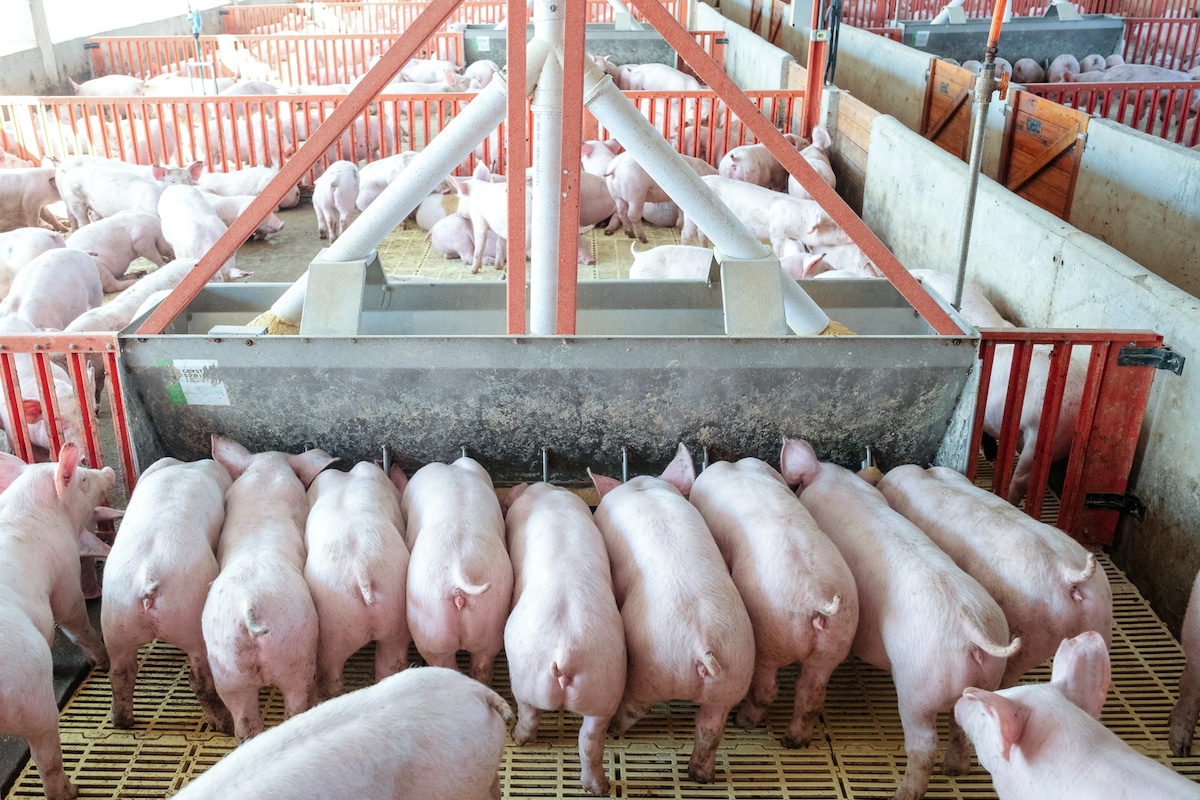
As pig biomass has expanded, Crystal Spring Hog Equipment has continuously adapted feeder ergonomics to match changing animal morphology:
- Trough Ergonomics & Width: Original industry feeder designs utilized 12-inch (30.5 cm) spaces. As market weights surged past 250 lbs (113 kg), shoulder width became a primary constraint, forcing pigs into unnatural eating angles and limiting water access at nipple drinkers.
- Optimized Eating Spaces: Crystal Spring expanded standard eating spaces to approximately 15 inches (38.1 cm), allowing pigs weighing over 300 lbs (135 kg) unhindered access to feed and integrated drinkers without physical stress or contortion.
- Structural Durability: During extreme holding periods—such as supply chain delays or disease outbreaks where pigs reach 325+ lbs (147 kg)—our stainless-steel finishing feeders have demonstrated exceptional structural integrity while supporting uninterrupted Average Daily Gain (ADG).
Preparing for the 350-lb Market Hog
If market weights maintain their current trajectory, average finishing weights could approach 350 lbs (159 kg) in the coming decades. Designing for future heavy-weight production requires continuous innovation in trough depth, shelf adjustment precision, and water delivery systems.
At Crystal Spring, we don't just manufacture stainless steel hardware—we develop precision feeding technology engineered to handle the physical demands of modern herds. As finishing weights continue to evolve globally, our engineering team remains focused on creating equipment solutions that optimize feed intake, eliminate wastage, and deliver long-term durability.
To learn more about how Crystal Spring feeding equipment can optimize feed conversion and growth performance in your finishing barns, contact our team at info@cshe.com or via WhatsApp/Phone at +1 (402) 227-8228.